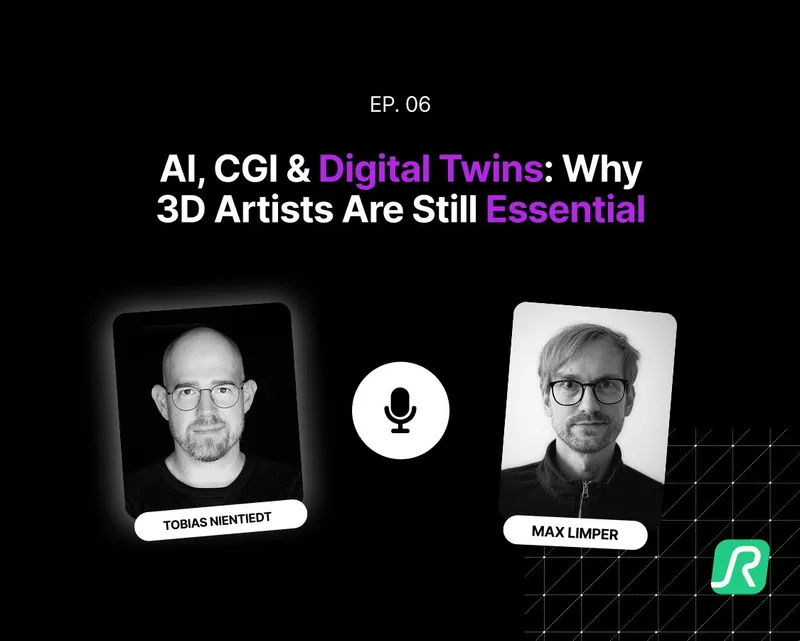
AI, CGI & Digital Twins: Why 3D Artists Are Still Essential: Insights from Tobias Nientiedt
Table of Contents
Is AI really about to replace 3D artists?
In Episode 6 of Virtual, For Real, we explore this question with Accenture’s Tobias Nientiedt, a seasoned 3D & CGI generalist with years of experience working across studios, enterprise environments, and large-scale 3D production pipelines.
Rather than leaning into fear-driven narratives, Tobias offers a realistic, production-tested perspective on how AI fits into today’s CGI workflows, and where it still falls short.
Follow us on a deep dive into years of learnings and state-of-the-art 3D & AI workflows for eCommerce and enterprise, where we discuss sample-less production, CAD-based pipelines, furniture CGI, 3D-powered retail experiences, digital twins, AI, the role of art direction, and real-world projects delivered at Accenture for global brands.
From 3D Foundations to Digital Twins
Tobias shares how his journey in 3D evolved over the years, from traditional CGI and studio work to complex enterprise-scale 3D and digital twin projects. His experience spans a wide range of production contexts, including furniture CGI, sample-less production workflows, CAD data usage, and scalable 3D pipelines for retail and eCommerce.
Working in these environments requires a high level of accuracy, consistency, and repeatability, as well as the ability to respond precisely to client feedback. These are exactly the areas where AI, despite its rapid progress, still struggles today.
Digital Twins, Retail & Enterprise Constraints
A key part of the conversation focuses on digital twins and their growing role in retail and enterprise use cases. From large product catalogs to configurators and immersive 3D-powered retail experiences, digital twins enable brands to scale content creation while maintaining quality and brand consistency.
Tobias also touches on enterprise projects delivered at Accenture, including collaborations with large global brands such as Nestlé, highlighting how 3D is increasingly embedded in real business workflows, not just marketing visuals.
AI in Production: The Reality Check
While AI can generate impressive visuals in seconds, Tobias explains why it’s not yet viable for high-end, client-driven production such as automotive content or enterprise-level campaigns.
The main challenge? Control.
Clients expect exact adjustments, predictable iterations, and full creative direction. In professional production environments, especially those involving CAD data, product accuracy, and strict brand constraints, current AI tools still lack the level of control required to replace traditional CGI workflows.
AI Is a Tool, Not a Threat
One of the strongest messages of the episode is that AI should be viewed like any other technological shift in creative industries:
“It’s just another tool in the toolbox.”
AI can dramatically speed up tasks such as environment creation, early concepting, or visual exploration, but only in the hands of artists who already understand lighting, materials, composition, storytelling, and art direction.
Without this foundational knowledge, AI outputs remain generic, hard to control, and difficult to integrate into real production pipelines.
Why Fundamentals Still Win
Tobias emphasizes that the most valuable creatives going forward will be those with strong foundational knowledge. Understanding photography, on-set workflows, and traditional CGI doesn’t become irrelevant with AI, it makes artists better AI users, not obsolete ones.
This is especially true in professional contexts where quality, consistency, scalability, and client expectations matter more than speed alone.
Final Takeaway
AI won’t replace 3D artists, but it will reward those who adapt.
The future belongs to creatives who combine artistic expertise, production experience, and modern tools to build smarter, faster, and more scalable 3D workflows, across eCommerce, retail, digital twins, and enterprise use cases.
Meet the Author

DGG Team
The 3D Pipeline Company
DGG is on a mission to connect the real and virtual by making 3D models as easy to handle as 2D images.