Museum of Digitized Heritage: Bringing Large-Scale Cultural Heritage to VR with RapidPipeline
Table of Contents
How Shanghai Jiao Tong University optimized massive heritage models for Meta Quest and Apple Vision Pro with RapidPipeline
About the project
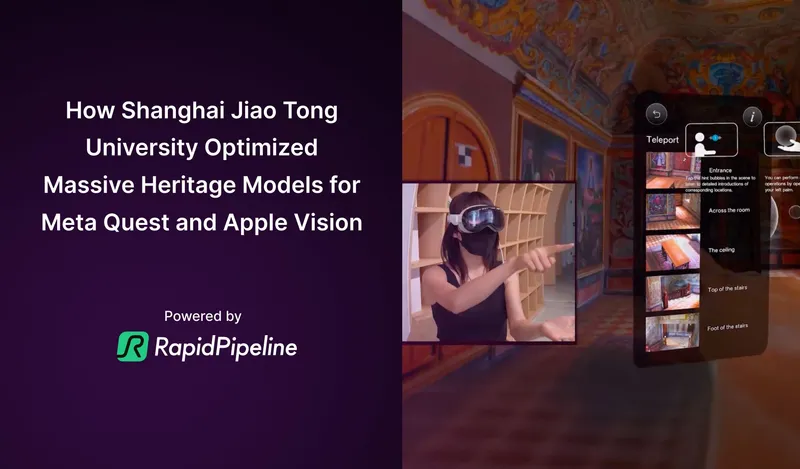
The Museum of Digitized Heritage is a free virtual reality application that allows users to explore highly detailed 3D scans of cultural heritage sites. Available on Meta Quest and Apple Vision Pro, the app showcases churches, archaeological sites, and historical buildings digitized through photogrammetry and LIDAR.
The project is led by G. Alan Rhodes, who is a tenured professor at Shanghai Jiao Tong University, where he leads the Future Museum Studio and is a faculty member of the Institute of Cultural and Creative Industry. It brings together academic research, cultural preservation, and immersive technologies to make heritage sites accessible to a global audience.
The challenge: massive scans, real-time constraints
The 3D models used in the project originate from large-scale heritage scans, some reaching millions of vertices. While these datasets are ideal for documentation and research, they pose major challenges when deployed in real-time VR environments.
Although Apple Vision Pro can handle relatively complex assets, Meta Quest requires aggressive optimization to maintain performance, frame rate, and user comfort. The team needed to significantly reduce model complexity while preserving visual fidelity, spatial immersion, and surface detail.
Traditional 3D workflows proved time-consuming and difficult to iterate on, especially in an academic context where time, resources, and advanced 3D expertise are limited.
The solution: RapidPipeline as a VR optimization backbone
RapidPipeline became a key component of the project’s optimization workflow. The platform enabled the team to:
- Rapidly test multiple optimization configurations
- Simplify complex meshes while preserving visual quality
- Optimize textures and atlasing for real-time rendering
- Prepare platform-specific outputs for both Meta Quest and Apple Vision Pro
By leveraging RapidPipeline’s automated processing and presets, the team could iterate quickly and efficiently, exploring different trade-offs between quality and performance without relying on lengthy manual workflows.
Close collaboration with the RapidPipeline technical team further helped refine the optimization approach for large, immersive environments rather than isolated objects.
The result: immersive VR experiences across devices
Thanks to RapidPipeline, the Museum of Digitized Heritage team successfully deployed highly detailed cultural heritage environments on both Meta Quest and Apple Vision Pro.
The optimized models maintain a strong sense of scale and immersion while running smoothly on constrained VR hardware. This made it possible to include sites that would otherwise have been excluded due to performance limitations.
RapidPipeline proved instrumental in turning raw, research-grade scans into VR-ready experiences, enabling broader access to cultural heritage through immersive technology.
Education at the core
Beyond this specific project, RapidPipeline has become part of the educational ecosystem around it. Alan actively recommends the platform to his students and colleagues for use in academic projects, thesis work, and VR experimentation.
To support this type of initiative, RapidPipeline offers a free EDU licensing program, allowing students worldwide to access the platform using their institutional email address. This makes it easier for universities and students to work with complex 3D data and prepare real-time experiences without additional cost.
Best-in-Class 3D Processing in Your Favorite Tools.
100% Local Processing via Desktop Software.
Meet the Author

DGG Team
The 3D Pipeline Company
DGG is on a mission to connect the real and virtual by making 3D models as easy to handle as 2D images.