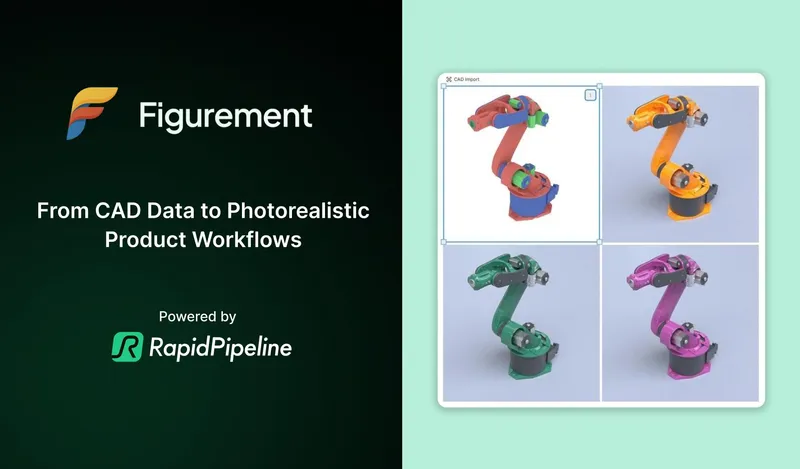
From CAD Data to Photorealistic Product Workflows: Figurement x RapidPipeline
Table of Contents
Engineering CAD data already defines the product in most organizations. Geometry, proportions, and technical specifications are captured in precise models long before a product reaches the market.
However, when teams need to evaluate product variations, test materials, or align stakeholders around design decisions, that same product design and engineering data often becomes difficult to use.
CAD models are built for engineering precision, not for visualization workflows. Preparing them for rendering or collaborative review typically requires complex conversion steps, manual optimization, and repeated coordination between teams.
As a result, product visualization workflows can become fragmented. Engineering, design, and commercial teams may end up working with different representations of the same product, slowing down iteration cycles and making it harder to reach decisions quickly.
To address this challenge, Figurement and RapidPipeline worked together to bring product design and engineering-defined product data directly into collaborative visualization environments.
The Challenge: Making CAD Data Usable for Visualization
In most product organizations, CAD data serves as the foundation for product definition. But while it contains the geometry and technical detail teams need, it is not inherently ready for collaborative visualization workflows.
Engineering models are often complex, heavy, and optimized for precision rather than speed or visual exploration. Before they can be used in photorealistic environments, they typically need to go through multiple preparation steps, often involving manual conversion and repeated back-and-forth between teams.
This creates friction across the product development process. Product designers, engineering, design, and commercial teams may all be working toward the same goal, but not from the same visual reference.
Bridging that gap between product design, engineering definition, and visual product evaluation is where the integration between Figurement and RapidPipeline creates value.
The Integration: RapidPipeline Inside Figurement
Figurement provides a platform for collaborative photorealistic product visualization, enabling teams to explore product variants, evaluate materials, and review product decisions through realistic digital representations.
To support this workflow, Figurement integrated RapidPipeline’s automated CAD processing technology.
With RapidPipeline embedded in the import pipeline, product design and engineering CAD models can be ingested across a wide range of industry formats and automatically prepared for visualization.
Instead of requiring manual conversion pipelines, RapidPipeline processes engineering models during import, transforming complex CAD geometry into visualization-ready assets that can be used directly inside Figurement’s collaborative environment.
This allows teams to move seamlessly from product design and engineering definition to photorealistic visualization without additional preparation steps.

The Results
By connecting product design and engineering CAD data directly with collaborative visualization workflows, the integration removes many of the friction points that traditionally slow down product development.
Product teams can now work with design and engineering-defined models inside the same environment where product decisions are evaluated.
This enables teams to:
- Compare product variants under identical visual conditions
- Evaluate materials and color decisions earlier in the process
- Reduce repeated render preparation cycles
- Align engineering, design, and commercial teams around the same visual reference
Instead of relying on disconnected pipelines, teams can now explore product options using a shared representation of the product derived directly from product design and engineering data.
Looking Ahead
As product experiences increasingly rely on high-quality visual representations, the ability to connect product design and engineering data with visualization workflows becomes essential.
The integration between Figurement and RapidPipeline represents an important step toward bridging these worlds.
By enabling product design and engineering CAD data to flow directly into collaborative photorealistic environments, product teams can move faster from design exploration to product decisions.
Industrial design and engineering data already defines the product.
Together, Figurement and RapidPipeline help ensure it can also power the way those products are evaluated, visualized, and refined across the organization.
Meet the Author

DGG Team
The 3D Pipeline Company
DGG is on a mission to connect the real and virtual by making 3D models as easy to handle as 2D images.