From CAD to Digital Twins, Building 3D Pipelines for the AI Era : Insights from Jed Fisher
Table of Contents
As AI becomes part of almost every digital workflow, one question is becoming increasingly important for companies working with 3D product data:
Where does AI actually add value, and where does traditional 3D remain essential?
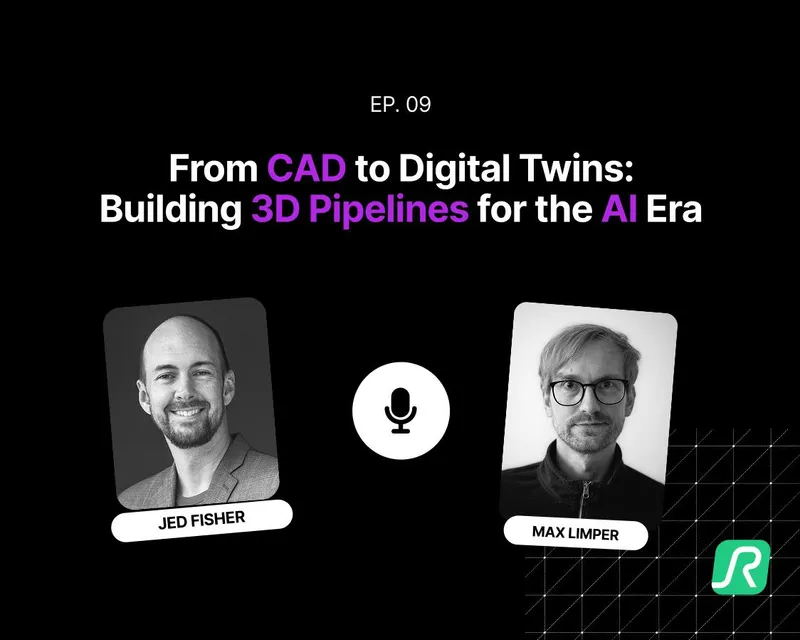
In a recent episode of Virtual, For Real, RapidPipeline CEO Max Limper sat down with Jed Fisher, Managing Partner at 4D Pipeline, to discuss the evolution of enterprise 3D, digital twins, automation, open standards, and the role AI will play in what comes next.
Drawing on decades of experience across automotive, aerospace, fashion, retail, manufacturing, and AEC, Jed shared a perspective that goes far beyond the current AI hype.
From 3D visualization to connected digital twins
Enterprise 3D has come a long way.
Years ago, the challenge was often simply making complex CAD data usable outside engineering. Product imagery, technical documentation, training material, sales experiences, and other downstream content could take days or even weeks to produce.
Today, the question is no longer whether companies can create digital representations of their physical products.
The challenge is how to create them once, keep them connected to the source data, and reuse them across the organization.
This becomes especially important as 3D moves beyond engineering into marketing, e-commerce, sales, training, XR, and increasingly AI-driven applications.
The hidden cost of disconnected 3D workflows
One recurring problem is fragmentation.
Different teams often create their own 3D experiences independently. Engineering has one workflow, marketing works with an external agency, another team builds a configurator, and someone else creates assets for a real-time application.
The result can be several versions of the same product, created for different purposes and maintained separately.
Jed shared the example of a large manufacturer that discovered 38 different digital twin experiences across the organization, including several built for exactly the same purpose.
The technology itself was not necessarily the problem.
The lack of a connected pipeline was.
For companies looking to scale 3D, the goal should therefore be to move away from isolated projects and toward reusable infrastructure built around a common source of product data.
Automation changes the economics of 3D
This is where automation becomes particularly powerful.
Instead of rebuilding assets every time a new image, experience, or channel is required, companies can create workflows that automatically transform existing product data into the formats needed downstream.
That means more content, more variations, and more applications without a proportional increase in production effort.
And once that pipeline exists, changes made upstream can flow automatically into downstream experiences.
This shifts 3D from being treated as an expensive content-production exercise to becoming part of a scalable digital product infrastructure.
Why USD, glTF and MaterialX matter
Open standards are another key part of making this possible.
Enterprise workflows rarely rely on a single 3D application. CAD systems, DCC tools, real-time engines, web applications, and rendering environments all need to exchange information.
Jed highlighted three standards in particular:
- USD for composition, collaboration, and complex multi-tool workflows
- glTF as a lightweight delivery format for efficient runtime and web experiences
- MaterialX for more consistent material definitions across tools and platforms
Standards reduce the need to continuously recreate or manually convert assets and make it easier to maintain a consistent digital representation of a product.
For companies working at scale, interoperability is not simply a technical detail. It is a fundamental part of building sustainable 3D pipelines.
AI vs. 3D: judged vs. specified
Perhaps the most useful distinction from the conversation was Jed's way of describing where AI and traditional 3D each perform best:
“AI is strong where the output is judged, and 3D is strong where the output is specified.”
For ideation and concept development, generative AI can be extraordinarily powerful.
Designers can rapidly explore different shapes, environments, styles, and directions with very little production overhead.
But when a product needs to be manufactured, measured, configured, or represented precisely, requirements change.
Dimensions matter. Materials matter. Geometry matters. Tolerances matter.
That is where CAD and structured 3D data remain essential.
The most valuable workflows will therefore likely combine both approaches rather than treating AI and traditional 3D as competing technologies.
Preparing 3D data for the AI era
AI will also change how people interact with digital twins.
LLMs can make complex 3D systems easier to navigate and allow users to interact with product data without needing to be expert 3D users. New interfaces and agent-driven workflows can increasingly connect AI directly to digital tools and pipelines.
But the quality of those experiences will still depend heavily on the data underneath them. The long-term differentiator may not simply be whether a company uses AI, eventually, almost every organization will.
Instead, the advantage may belong to companies that have clean, structured, well-tagged digital product data that both automation and AI can reliably use.
The next generation of enterprise 3D
The future of enterprise 3D is therefore not simply about generating more content.
It is about creating connected systems where CAD, 3D assets, materials, automation, open standards, real-time experiences, and AI can work together.
Companies that build that foundation now will be in a much stronger position to scale their digital twins, and take advantage of whatever comes next.
🎙️ Want to hear the full conversation?
Listen to Max Limper and Jed Fisher discuss digital twins, enterprise 3D, automation, open standards, and AI in the latest episode of Virtual, For Real.
▶️ YouTube: https://youtu.be/T5zf-wB1GR8
🎧 Spotify, Apple Podcasts and more: https://rapidpipeline.podcast.com/
Meet the Author

DGG Team
The 3D Pipeline Company
DGG is on a mission to connect the real and virtual by making 3D models as easy to handle as 2D images.