Table of Contents
For more than two decades, few companies have shaped the evolution of 3D as profoundly as IKEA.
Long before real-time 3D became a buzzword, and years before augmented reality entered everyday life, IKEA was already exploring how digital content could replace traditional photography, at scale.
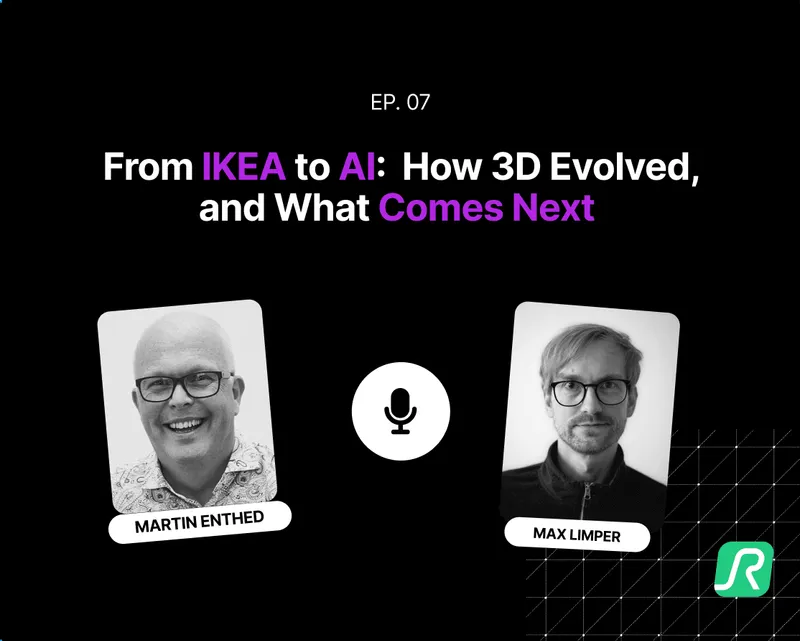
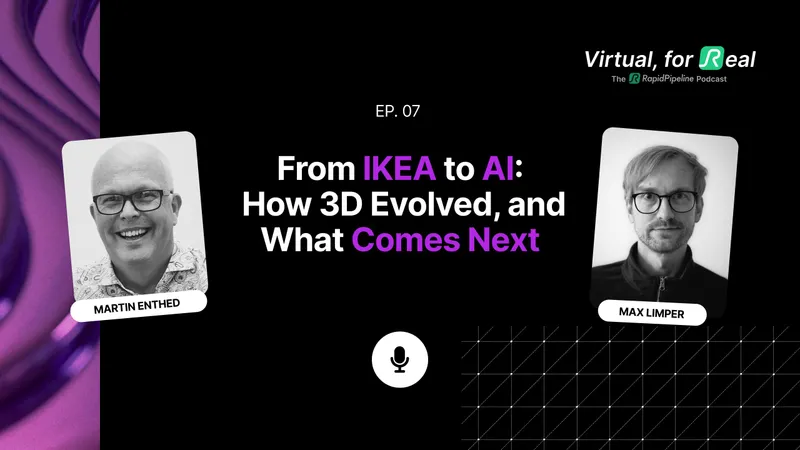
In this episode of Virtual, For Real, we sat down with Martin Enthed, who played a key role in that journey.
What followed wasn’t just a conversation about 3D. It was a reflection on how an entire industry evolved, from handcrafted CGI to automation, and now to AI-driven possibilities, and why, despite all the progress, we’re still only scratching the surface.
Note: At the time of recording, Martin’s new company had not yet been announced publicly. He is now working at Physicl. Learn more at Physicl.ai.
When 3D Was Still Experimental
Back in the early days, using CGI for product visualization wasn’t obvious.
It required building workflows from scratch, convincing stakeholders, and solving technical challenges that didn’t yet have standard solutions. But IKEA saw something early on. If you could digitize a product once, you could reuse it everywhere.
That idea became a quiet revolution.
A single digital asset could power catalogs, websites, configurators, and marketing campaigns. What seems standard today was, at the time, a radical shift in thinking. And over the years, that foundation evolved into something much bigger.
From static images to interactive experiences. From controlled studio renders to augmented reality in people’s homes.
At every step, IKEA wasn’t just adopting technology, they were shaping expectations.
The Illusion of the “Perfect Button”
For years, the industry has been chasing a simple idea. A button you press, and a perfect 3D asset comes out.
Clean, optimized, ready for anything.
We’re closer than ever to that vision, but something fundamental still stands in the way.
3D is not just visual. It’s structural.
An image only needs to look right. A 3D model needs to behave correctly. It needs to exist in space, respond to light, integrate into pipelines, and perform across devices. That hidden complexity is what makes true automation so difficult.
And why the dream, while closer, is still not fully real.
AI Changed the Game, But Not Everywhere
In the past few years, AI has dramatically accelerated what’s possible.
Generating images has become almost effortless. What once required hours of work can now be done in seconds. The results are often beautiful, sometimes indistinguishable from reality.
But this progress hasn’t translated equally to 3D.
You can generate a perfect image of an object. But turning that image into something usable in a 3D workflow is another story entirely. The geometry is missing. The structure isn’t there. The data can’t be easily reused.
So while AI solved one part of the problem, it exposed another.
And that gap is now one of the most important frontiers in the industry.
Beyond Objects: The Rise of Spatial Understanding
What comes next might not be about creating objects at all.
It might be about understanding spaces.
Instead of focusing on individual assets, the challenge becomes capturing how environments exist and behave. Not just how things look, but how they interact. How light moves, how materials respond, how people navigate through a scene.
This shift changes everything.
Because once a system understands space, it doesn’t just generate visuals. It begins to recreate reality.
We’re already seeing early signs of this transition. New techniques are emerging, new tools are appearing, and new ways of capturing environments are being explored. But turning these experiments into reliable, everyday tools is still a major step.
And that’s where the real work lies.
A Field in Constant Motion
One of the most striking realities today is the speed at which everything is evolving.
New ideas appear constantly. New companies emerge. New approaches challenge what was considered best practice just months ago.
In that kind of environment, certainty disappears.
What matters instead is the ability to stay close to the movement. To observe, test, and understand what actually creates value. Because not everything that looks impressive ends up being useful in production.
And not every breakthrough survives contact with real-world constraints.
What the Next Decade Might Look Like
If the last twenty years were about digitizing products, the next phase might be about digitizing reality itself.
Not just creating assets, but building systems that understand and generate entire environments.
It’s a subtle shift, but a profound one.
And while the path forward is still uncertain, one thing is clear. The foundations are already in place, and the pace isn’t slowing down.
Meet the Author

DGG Team
The 3D Pipeline Company
DGG is on a mission to connect the real and virtual by making 3D models as easy to handle as 2D images.