Table of Contents
Creating a high-quality 3D digital twin from CAD still involves more manual work than it should.
Geometry needs to be processed and optimized. Product references need to be interpreted. Materials need to be selected, created, assigned and adjusted before an asset is ready for visualization, marketing content or other downstream applications.
While many parts of this process can already be automated, creating the final photorealistic appearance of a product has remained one of the biggest bottlenecks.
RapidPipeline AI is designed to change that.
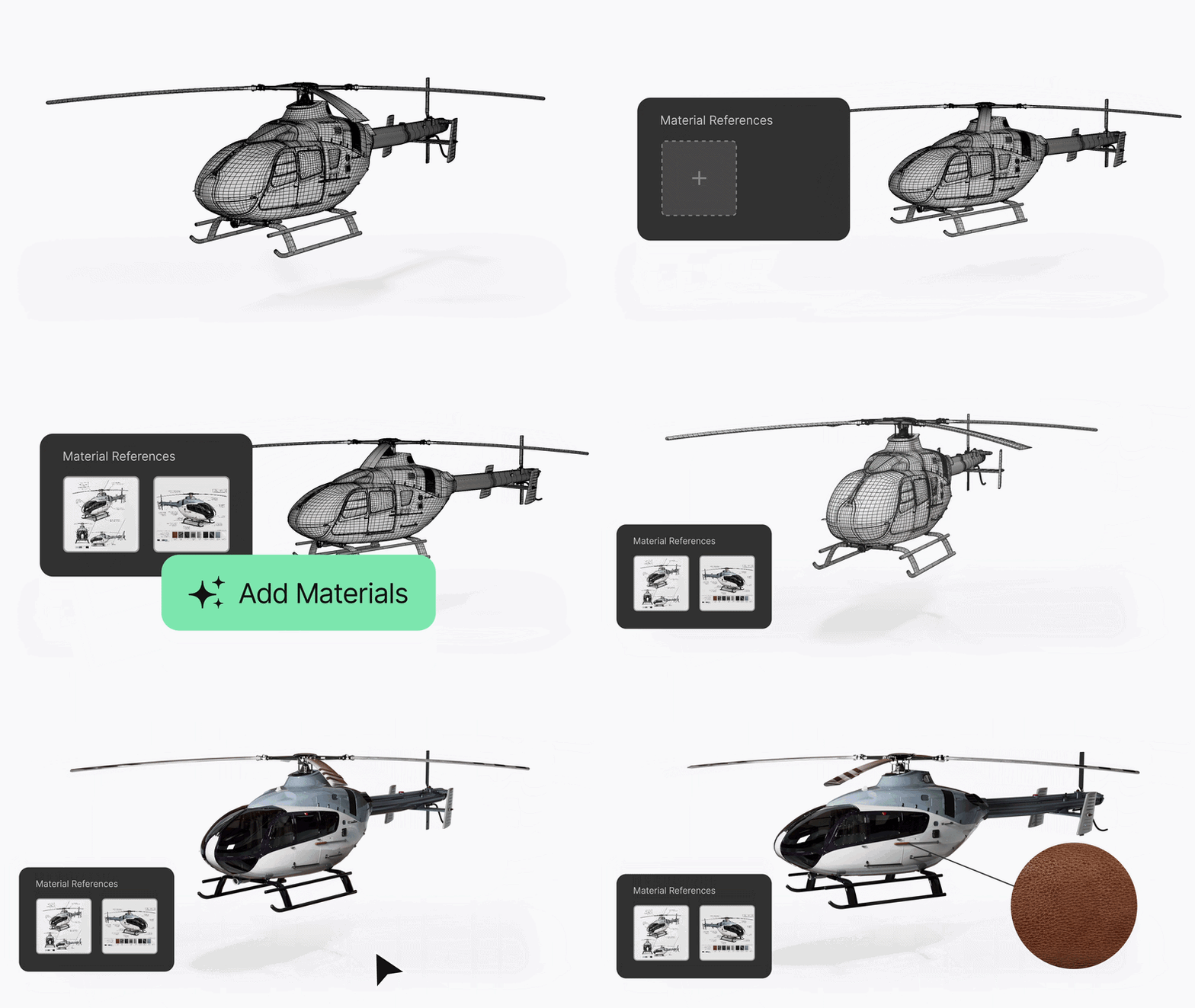
Today, we are introducing a new product, with private beta registration now open for select enterprise clients: RapidPipeline AI turns product CAD or 3D models, together with visual references and material information, into high-fidelity, photorealistic 3D digital twins.
After more than 6 million CAD and 3D assets processed through RapidPipeline, this represents the next step toward our vision of end-to-end automation from CAD to content.
From Raw 3D Data to Photorealistic Digital Twins

Traditionally, turning a CAD model into a realistic digital representation of a physical product requires significant manual input.
A 3D artist needs to understand how the real product looks, identify the materials used across individual components, select or create suitable materials, assign them to the geometry and refine the result until it matches the original product.
When dealing with large product catalogs, this quickly becomes difficult to scale.
RapidPipeline AI introduces automation into this process.
Similar to working with a 3D design agent, you start with your product CAD or 3D model and provide supporting visual information, such as product photography, design imagery or material references.
RapidPipeline AI uses these inputs to interpret the product appearance and create a render-ready, photorealistic 3D digital twin using high-quality 3D materials.

The result is a workflow in which one of the most time-consuming stages of digital twin creation can become significantly more automated.
And automation does not mean losing control.
RapidPipeline AI output remains editable and based on open 3D standards, allowing artists and technical teams to review, adjust or further process assets whenever needed.
Built to Scale Content Creation
The demand for high-quality 3D assets continues to grow across industries.
For marketing teams, a single product can require imagery, video, interactive 3D experiences, configurators, AR applications and other digital content across multiple channels.
At the same time, emerging Physical AI applications increasingly depend on accurate digital representations of real-world products and environments.
Both require the same foundation: scalable access to high-quality 3D digital twins.
RapidPipeline AI is designed to help remove the manual data preparation bottleneck between product data and these downstream experiences.
Instead of preparing each asset individually, organizations can move toward workflows in which large volumes of product data are transformed into usable 3D content through automation.
This makes digital twins easier to scale from individual pilots to enterprise-level production.
The Next Step in CAD-to-Content Automation
RapidPipeline AI builds on years of work around automated CAD and 3D data processing.
RapidPipeline already helps companies convert, optimize and prepare complex 3D assets for real-time applications and automated content workflows.
With AI-driven material assignment and appearance creation, we are now extending that automation further into the creative preparation process.
The goal is simple:
Make the journey from raw product data to production-ready 3D content faster, more scalable and increasingly automated.
Following the private beta phase (see below), RapidPipeline AI is planned to become available across our different interfaces and deployment options, including GUIs, API-based automations, on-premise CLI workflows and agentic pipelines.
This means companies will be able to integrate digital twin creation into the environment that best fits their scale and use case, from individual asset workflows to fully automated enterprise pipelines.

Built for Marketing Content and Physical AI
RapidPipeline AI is being developed for two rapidly growing areas in particular.
For marketing and content production, digital twins can become the foundation for scalable product imagery, video, e-commerce experiences, real-time 3D and XR.
For Physical AI, high-quality 3D representations can support increasingly automated workflows involving digital twins, simulation and machine-driven applications.
In both cases, the challenge is no longer simply creating a 3D asset.
It is creating large volumes of accurate, visually convincing and reusable 3D assets efficiently enough to support production at scale.
That is the challenge RapidPipeline AI aims to address.
Join the RapidPipeline AI Private Beta
 We are now inviting selected companies to join the upcoming RapidPipeline AI Private Beta.
The program is particularly relevant for:
- Enterprises working with CAD-to-Digital-Twin workflows
- Companies managing large volumes of product CAD or 3D data
- 3D GenAI platforms looking to transform generated geometry into high-quality, materialized assets
- Organizations exploring scalable 3D workflows for Marketing Content or Physical AI
If your company fits this profile, we would love to work with you and learn from your workflows as we continue developing RapidPipeline AI.
Join the RapidPipeline AI Private Beta and help shape the next generation of automated 3D digital twin creation.
Meet the Author

DGG Team
The 3D Pipeline Company
DGG is on a mission to connect the real and virtual by making 3D models as easy to handle as 2D images.