
The Complete Creo to USD Conversion Guide
General Information
This guide is part of the RapidPipeline 3D Formats Knowledge Database.It shows how to convert Creo to USD, if you'd like to know more about the formats, please check out the following links:
Converting and Optimizing Creo Files to USD
There are various ways to convert between Creo and USD. With RapidPipeline, you can easily convert and and optimize Creo files, at scale. It supports USD, as well as many other file formats (examples: PLY, OBJ, VRM, FBX, glTF, STL, USDZ), at high quality.
Below you can find a video explaining how to convert your files:
What are Creo and USD files commonly used for?
The Creo file is a format mostly used for Advanced parametric 3D CAD/CAM/CAE software for mechanical engineering and product development.
The USD file is a format mostly used for 3D modeling and rendering applications, and exchange of 3D authoring data.
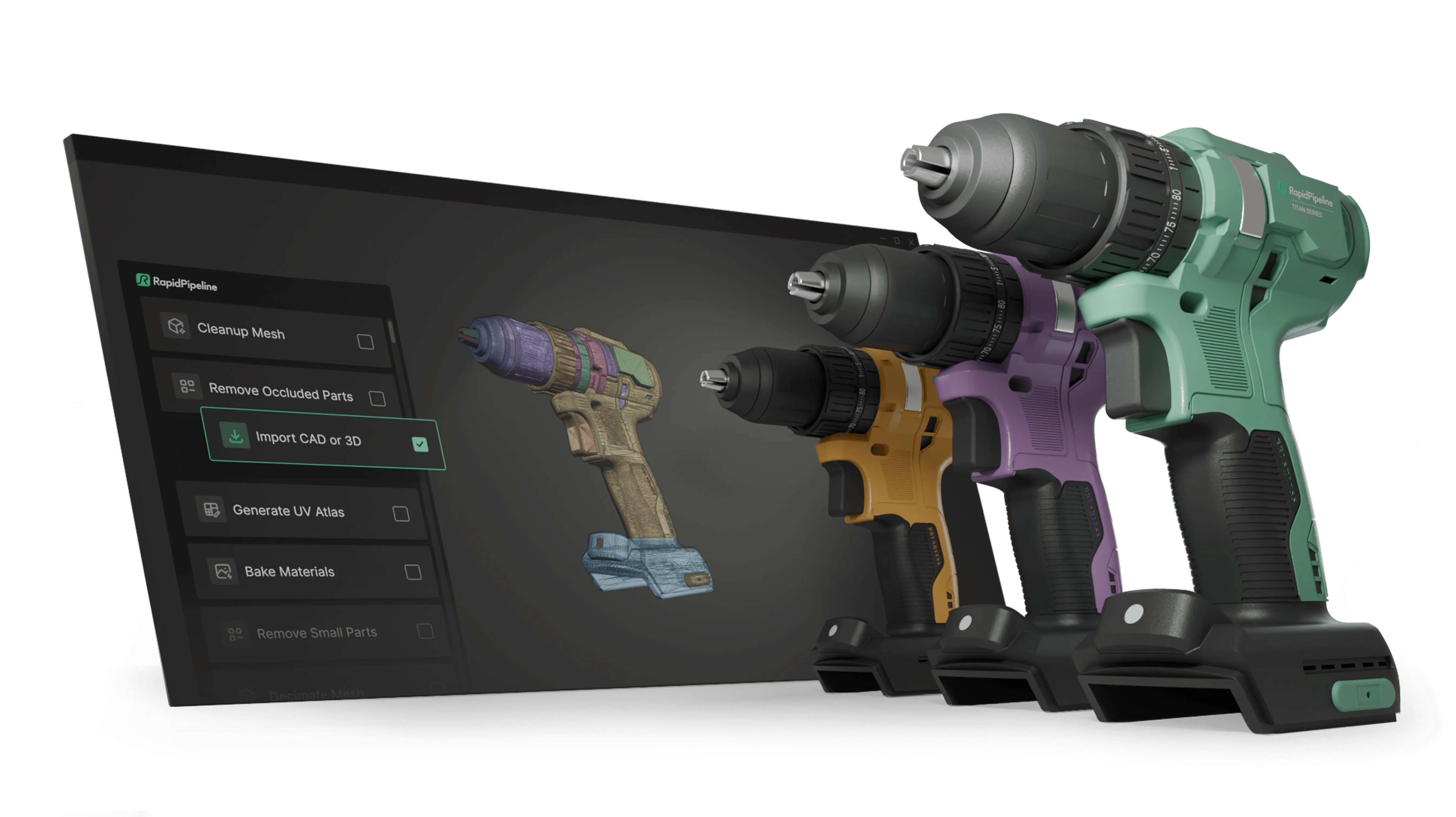
Create 3D digital twins for CGI & XR, faster than ever.
Turn your raw 3D or CAD into realistic digital twins.

Comparison of Features Supported by Creo and USD
| Feature | Supported by Creo | Supported by USD |
|---|---|---|
| PBR Materials | Partial0 | Yes |
| Transparent Materials | Yes | Yes |
| Vertex Colors | Partial1 | Yes |
| Materials | Yes | Yes |
| Embedded Textures | Partial2 | No |
| Normal Mapping | No | Yes |
| Procedural Textures | No | Yes |
| Texture Compression | No | Partial3 |
| Texture Transforms | Partial4 | Yes |
| Multiple UV Channels | Partial5 | Yes |
| Texturing | Partial6 | Yes |
| Hierarchical Scene Graph | Yes | Yes |
| Scene Composition | Yes | Yes |
| Scene Nodes | Yes | Yes |
| Quad Meshes | Yes | Yes |
| Free-Form Surfaces | Yes | Yes |
| Geometry Compression | No | No |
| Basic 3D Geometry | Yes | Yes |
| Standardized Format | Partial7 | Yes |
| Morph Targets | No | Yes |
| Skinned Animations | No | Yes |
| Rigid Animations | Yes | Yes |
| Animations | Yes | Yes |
Create 3D digital twins for CGI & XR, faster than ever.
Turn your raw 3D or CAD into realistic digital twins.
Limitations of Creo Files to USD Conversion Workflow
The following limitations should be taken into account when converting Creo files to USD format:
| Creo Feature (not supported by USD) | Limitation Details |
|---|---|
| Embedded Textures | Embedded Textures Support: Creo: Partial support | USD: No support   Creo Notes: Textures can be included with appearances but with limited embedding capabilities compared to graphics-focused formats. Impact: Embedded textures allow the storage and exchange of an entire 3D model and its materials within a single file, by embedding the texture images directly into the 3D file (and not storing them as separate image files). Without support for this feature, textures have to be stored in separate image files, and referenced from the main 3D model file. |
What's the best way to get Creo files into my 3D applications, and are there alternatives to using USD?
Doing 3D conversion right, especially at scale, can be tricky, as 3D data is in general a rather complex (yet very powerful!) medium. This also applies to Creo and USD files - the conversion guide above provides a rough first idea about that. Once you know what you would like to do, tools like RapidPipeline can help you perform the necessary steps, and to even automate the process for thousands or even millions of files.
Especially when introducing pipelines and workflows at scale in an enterprise context, it is usually good to rely on dedicated tools and expertise, making sure you do not introduce any steps into your 3D workflow that are detrimental to the final output's quality, or that take your team too much time (and money).
If you're interested to hire dedicated expertise from the best in the field to help your company reach your goals fast and reliably, please do not hestitate to contact DGG. Being the creators of RapidPipeline, and ambassadors for open 3D standards for more than a decade, we have been building some of the world's most advanced 3D pipelines, having processed many millions of 3D assets.
Therefore, our expertise will help you to reach your goals faster, at scale, and with the least possible friction, since we are focused on maximum interoperability.
To get started with 3D data conversion and optimization today, sign up for a free account!
If you have any questions, feel free to chat with our human team.
Create 3D digital twins for CGI & XR, faster than ever.
Turn your raw 3D or CAD into realistic digital twins.
Meet the Author

3D Knowledge Team
3D Technical Artists
RapidPipeline lets you convert, optimize and prepare your 3D models, easily. Try it today, or meet our human 3D experts. The Best-in-Class Tools for Your 3D Processing Jobs