Table of Contents
When 3D Careers Stop Being Predictable
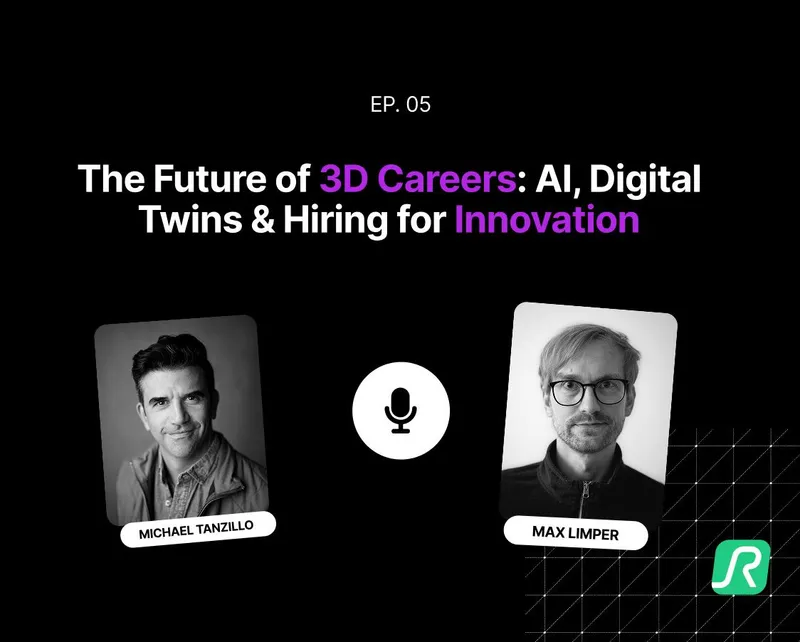
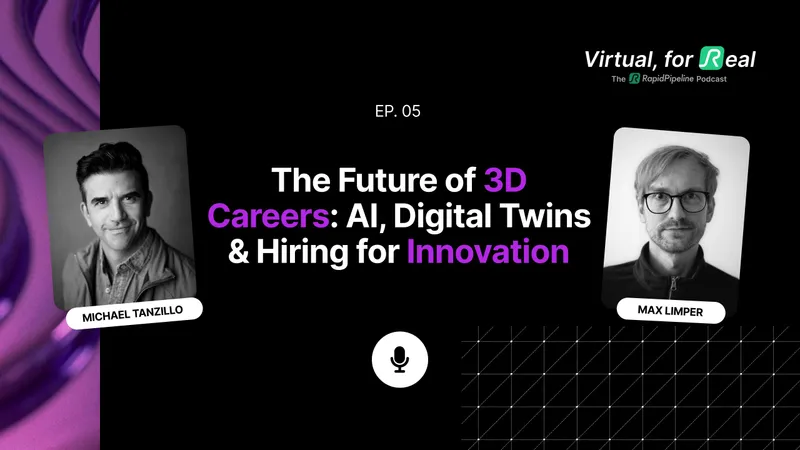
The 3D industry is evolving at an unprecedented pace. New AI tools emerge almost daily, workflows are constantly shifting, and long-established production models are being challenged from every angle. In Episode 05 of Virtual For Real, Max welcomes Michael Tanzillo from Adobe to explore what these changes really mean for 3D professionals today. Michael is also running “The 3D Artists”, a community for 3D artists interested in diving into real-world use cases and jobs outside of games and VFX.
Rather than leaning into fear-driven narratives about AI replacing artists, this conversation offers a thoughtful and experience-based perspective on how the industry is transforming, and why this moment represents a rare opportunity for those willing to evolve.
From Entertainment to Enterprise: A Career Built on Adaptation
Michael’s career path reflects many of the changes currently reshaping the 3D landscape. With a background in photography, he started in areas closely tied to games and entertainment, where visual quality and real-time performance were central concerns. Over time, his work expanded into enterprise contexts, where 3D is no longer just about creating compelling visuals, but about connecting assets to systems, data, and real-world processes.
This shift illustrates a broader evolution of the industry. 3D has moved far beyond its traditional boundaries and is now deeply embedded in sectors such as manufacturing, retail, and industrial design. In these environments, 3D becomes a strategic tool, one that supports decision-making, efficiency, and scalability.
Digital Twins as a New Foundation for Enterprise 3D
A central theme of the discussion is the growing importance of digital twins. Michael explains that digital twins are not simply detailed 3D models, but living representations of real-world objects or systems. They combine geometry with data, logic, and context, enabling companies to simulate, analyze, and optimize before acting in the physical world.
As digital twins gain traction across industries, they fundamentally change expectations around 3D pipelines. Accuracy, consistency, and integration become just as critical as artistic quality. This evolution pushes 3D artists and technical teams to rethink how assets are created, managed, and reused at scale.
Best of Both Worlds
In contrast to what some may think in the industry, Michael and Max quickly agreed that AI workflows will not be able to replace 3D technology, when it comes to visualizing 3D digital twins. Instead, 3D and AI must be seen as complimentary, powerful toolsets that enable skilled artists to produce more impressive content, within less time, while retaining a high level of visual quality and control, thanks to CGI being used for the digital twin itself – while AI can very well take care of background generation and similar forms of contextualization. The beach example perfectly illustrates this shift: instead of complaining about AI replacing 3D, a smarter approach is to combine both: use precise 3D where accuracy and brand matter, and AI for elements like sand, palm trees, or backgrounds, details that most companies would never have modelled before because the effort simply wasn’t worth it.
AI, Acceleration, and a Shifting Industry
AI is rapidly accelerating 3D workflows, but in practice, many professionals are struggling to keep up. Between production constraints and constant tool releases, adoption often lags behind innovation. The challenge is no longer about access to technology, but about making smart, sustainable choices, selecting what truly improves workflows rather than chasing every new breakthrough.
At the same time, this uncertainty is reshaping how companies think about both pipelines and hiring. Fixed workflows and predefined job titles are fading, replaced by a growing need for people who can navigate change, experiment, and help define what comes next.
What companies are increasingly looking for
- Profiles exploring AI and emerging 3D workflows
- Creative thinkers blending technical skills with experimentation
- People able to shape new pipelines, not just execute existing ones
For students and early-career professionals, this shift creates a rare opportunity. Fresh ideas, experimental projects, and hybrid skill sets now carry real weight, often more than long experience with legacy pipelines. Curiosity, adaptability, and initiative are becoming decisive advantages.
Looking Ahead
No one knows exactly what 3D roles will look like in five years, and that’s precisely the point. In an industry defined by rapid change, adaptability matters more than any single tool or title. Those who embrace evolution will help shape the future of 3D, rather than simply react to it.
Final Thoughts
This episode of Virtual For Real offers a clear message: AI and digital twins are not ending creative careers, they are transforming them. The future belongs to those who stay curious, experiment freely, and refuse to let outdated definitions limit their role.
🎧 Listen to the full episode to explore these ideas in depth and join the conversation.
Meet the Author
DGG Team
The 3D Pipeline Company
DGG is on a mission to connect the real and virtual by making 3D models as easy to handle as 2D images.