

How to Remesh and Bake Holes in Blender
Table of Contents
General Information
This guide is part of the RapidPipeline 3D Plugin Actions Knowledge Base. It shows how to Remesh and Bake Holes on Blender; if you'd like to know more about it, please check out the following links:
Best-in-Class 3D Processing in Your Favorite Tools.
100% Local Processing via Desktop Software.
Tutorials & Videos
- First step is to make sure the RapidPipeline Processor add-on for Blender is installed and ready to use.
- Select the wicker mesh by clicking on it in the
- In the 3D Viewport open the Sidebar (default hotkey n) and choose
- Choose the Action
- Press the button.
This tutorial contains these key points:
- Use the Blender add-on
- Select a part with intricate holes
- Run the "Remesh and Bake Holes" action
- Examine the results
This tutorial shows how use the RapidPipeline Processor add-on in Blender to simplify a 3D model. It walks through the use of the Remesh & Bake Holes action, and explains how to use it for closing holes and baking them into an alpha texture.
The asset used in this tutorial is a high-resolution model "wicker sofa" (https://skfb.ly/prBJM) by Md Imamul Hasan licensed under Creative Commons Attribution (http://creativecommons.org/licenses/by/4.0/).
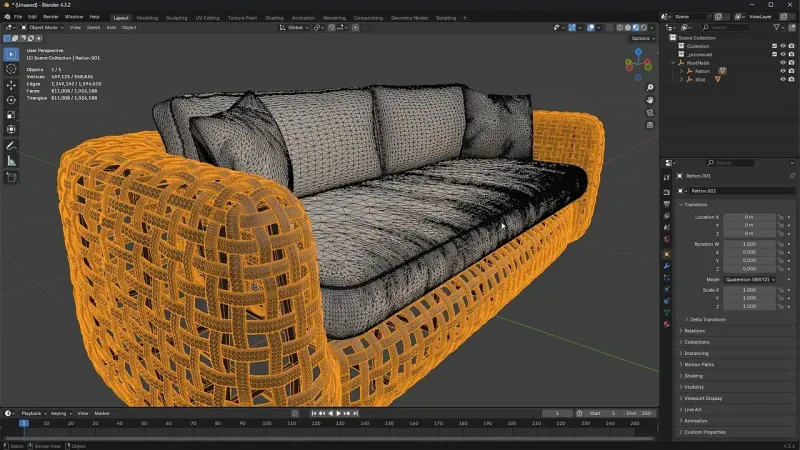
The input model has 811,008 triangles just for the wicker alone.
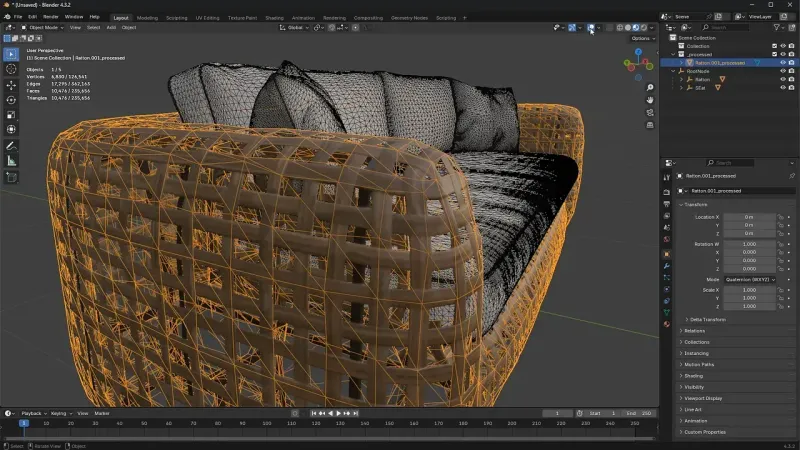
After processing, the wicker has only 10,476 triangles and uses an alpha texture for the holes.
The wicker has been remeshed, and the full complement of PBR textures were automatically baked from the high-resolution source meshes.
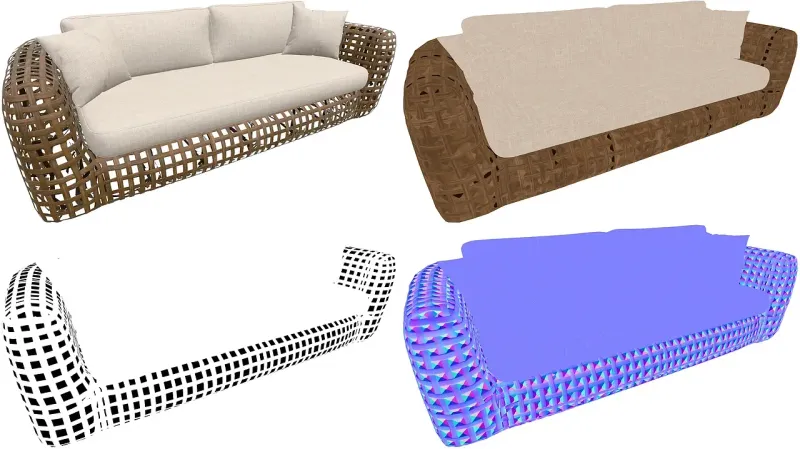
The remeshed wicker sofa (upper left), baked color (upper right), baked alpha (lower left), and baked normal (lower right).
Remesh and Bake Holes Action
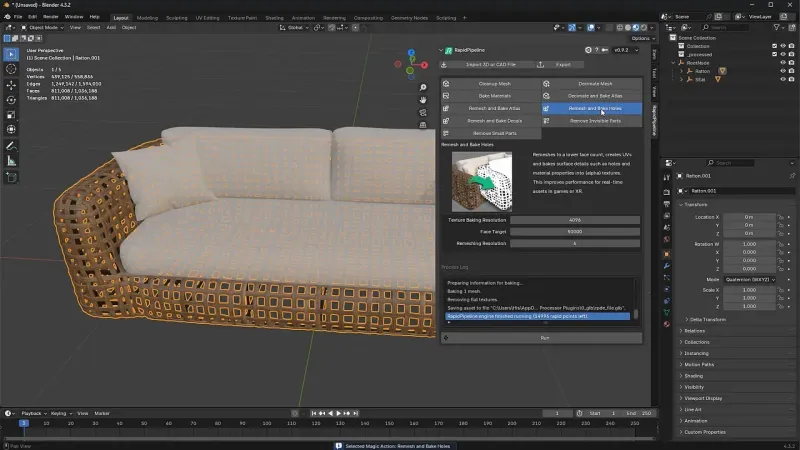
Examine the Results
To see the triangle counts, turn on Statistics in the Blender viewport.
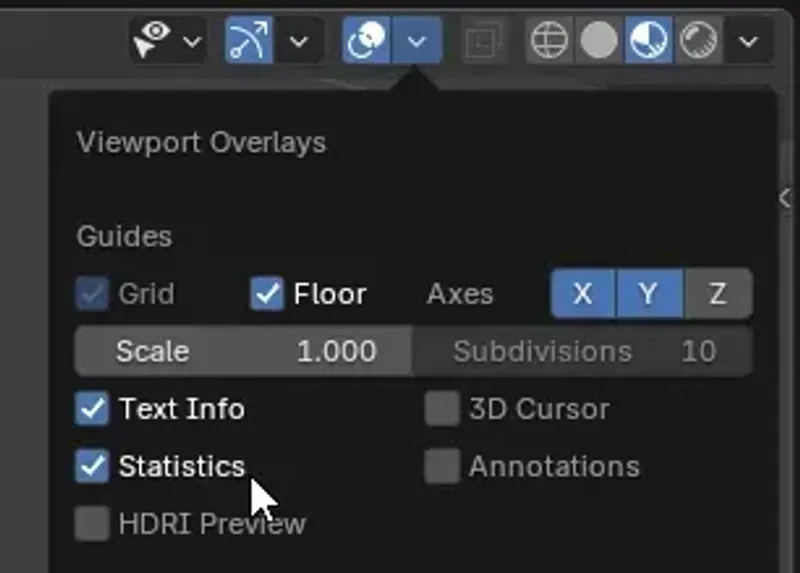
When the input wicker is selected, the total triangle count is 1,036,188 and the wicker alone is 811,008 triangles.
When the output wicker is selected, the total triangle count is 235,656 and the wicker alone is 10,476 triangles.
To examine the output in a web viewer, export a GLB file, then drag-and-drop into the glTF Sample Viewer. An exported GLB can also be uploaded to the RapidPipeline Web Platform for conversion into other formats, like USDz.
To get started with 3D data conversion and optimization today, sign up for a free account!
If you have any questions, feel free to chat with our human team.
Meet the Author

3D Knowledge Team
3D Technical Artists
RapidPipeline lets you convert, optimize and prepare your 3D models, easily. Try it today, or meet our human 3D experts. The Best-in-Class Tools for Your 3D Processing Jobs