
Introduction
December has a particular rhythm to it. The days get shorter, lights appear in windows, and familiar traditions quietly make their way back into everyday life. At DGG, that seasonal shift comes with a new 3D Model of the Month with Christmas spirit.

For December, we’re featuring a traditional German Christmas Pyramid, brought to life as a fully animated 3D model and prepared for AR. A small festive object, full of movement, mechanics, and a bit of nostalgia.
1. A Small Pyramid with a Long History
If you’ve ever walked through a German Christmas market, you’ve likely seen them spinning gently above candlelight: Christmas pyramids (Weihnachtspyramiden). These wooden structures combine craftsmanship, storytelling, and a simple physical principle: rising warm air from candles sets the carousel in motion.
They’re part aesthetics, part machine. That blend of charm and mechanics can also be found in 3D Ar. So, it was the perfect candidate for our Christmas Model of the Month.

Our model is a small Digital Twin of tradition: the carousel rotates, and the little figures feature subtle, mechanical-style animations that echo the handmade feel of the originals. Keeping the hand-crafted art, but making it last forever, digitally.
The model used in this article was created by Gabriel Leon (@el_cerilla). Sourced from TurboSquid. Used under the TurboSquid Standard License.
2. A Quick Detour: How 3D Animation Moves
Animation in 3D comes in different flavors, each with its own strengths and quirks. The general types are, very briefly:
Rigged / skinned animation relies on a skeleton that drives mesh deformation. Common for characters, but also useful for articulated hard-surface objects.

Rigid animation moves entire meshes via transform keyframes (rotation, translation, scale) without deformation. Clean, predictable, and perfect for mechanical motion.
Blendshapes / Morph Targets animate vertices directly, allowing for expressive deformation. They’re often used for organic motion or to add handcrafted, stop-motion-like characters.
For the Christmas Pyramid, we chose rigid animations. The movement is precise and mechanical, much like the real-world object it’s inspired by.
Best-in-Class 3D Processing in Your Favorite Tools.
100% Local Processing via Desktop Software.
3. How to Prepare Animated Models for AR
Animated AR models have a certain magic to them, especially when they show up on someone’s desk or living room table. Preparing them doesn’t need to be complicated, but it does require a bit of care.
Before optimization, it’s important that the source file is clean and predictable. In our case, the model originated in Blender, so we made sure to:
Apply all transformations (location, rotation, scale)
Confirm animation ranges and pivot points
This ensures consistent scale and behavior once the model leaves the DCC tool and enters an AR environment.
4. Optimize Animated Models for AR


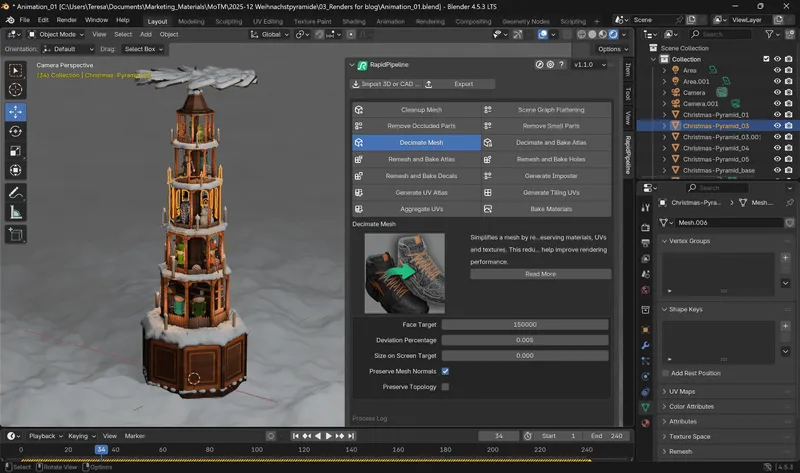
Once the model is ready, optimization can happen directly where you work, via our RapidPipeline plugins for Blender, Maya, 3ds Max, Unreal Engine, or Substance Painter, or through the RapidPipeline Web Interface.
Here are our suggestions for animated assets:
1. Geometry Reduction, with Care - Animated meshes reveal their topology more easily than static ones. Extremely aggressive face reduction can become visible during motion, especially when parts move relative to each other.
For the Christmas Pyramid, we settled at around 60% of the original face count, striking a balance between performance and visual stability.
2. Materials and Textures: Fewer, Smarter - If your model uses many materials or texture maps, there are several ways to simplify them:
Texture baking merges materials into fewer atlases, sometimes even a single one. It’s the most effective way to reduce draw calls and file size, though it requires careful balance between optimization and quality.
Atlas aggregation combines existing texture maps like puzzle pieces. It’s ideal when detailed textures are reused across many meshes. Check our Christmas Model of 2022.
Preserving UVs and materials can be the best choice when texture count is already reasonable and surface detail matters, like the faces of the little figures in our carousel. This is why we chose this method for our Model of the Month.
3. Animation-Specific Constraints - Some optimizations are naturally limited once animation enters the picture:
Node Flattening is not possible, since merging meshes animated independently would be problematic.
Occlusion Culling is also limited, since mesh visibility might change over the course of the animation.
Best-in-Class 3D Processing in Your Favorite Tools.
100% Local Processing via Desktop Software.
5. Exporting for AR
To make the pyramid accessible across devices, we prepared two standard AR formats:
GLB, used for Augmented Reality via ARCore on Android (with optional texture or mesh compression, like Draco).
USDZ, the go-to format for ARKit on Apple devices.
If you are interested in some more details on export for AR, you can check our dedicated guides on AR-Core and AR-Kit.
Note: Material systems differ slightly between the glTF and USD formats, so it’s worth keeping an eye on which material features translate universally, especially when targeting both platforms.
6. The result
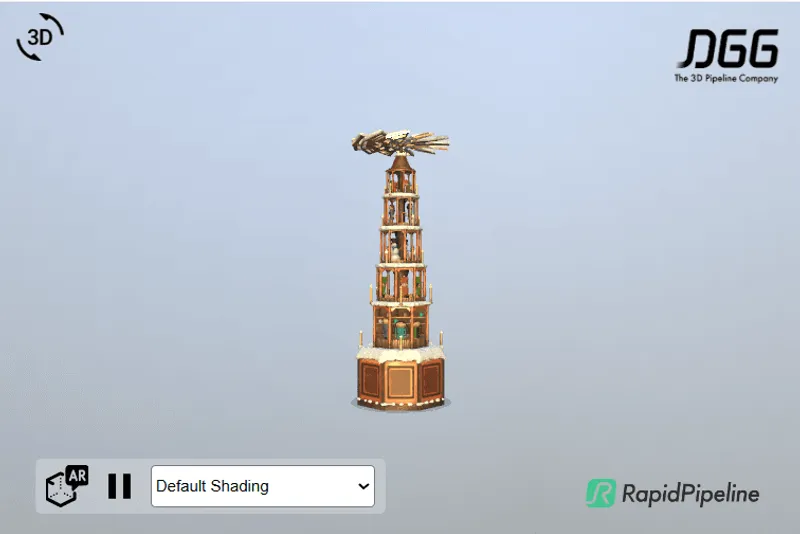
The original model was 168K faces and 53 MB. After optimization, the final animated model comes in at around 60,000 faces and 11 MB: compact, efficient, and ready for real-time AR.
It’s a small digital scene, but one that carries a piece of German Christmas tradition with it. No market stalls or mulled wine required, just place the pyramid on your desk and let it spin.
And if you’re working on animated models of your own this season, maybe destined as a modern kind of holiday greeting, RapidPipeline is ready when you are. Try it for free now!
Happy optimizing and happy holidays!
Meet the Author

Teresa
Technical 3D Artist
Teresa is a 3D Technical Artist at DGG, bringing with her a robust background in Animation and Game design. Driven by a passion for the intersection of art and technology, she relocated to Germany to pursue her artistic ambitions. Within DGG, Teresa plays a pivotal role in infusing the team with her artist's perspective, focusing on the creation of high-quality visual content and ensuring the quality assurance of tools. Her overarching goal is to continually evolve within the industry, delivering compelling visual solutions that resonate with DGG's mission of streamlining and scaling 3D content preparation.
You might be interested in